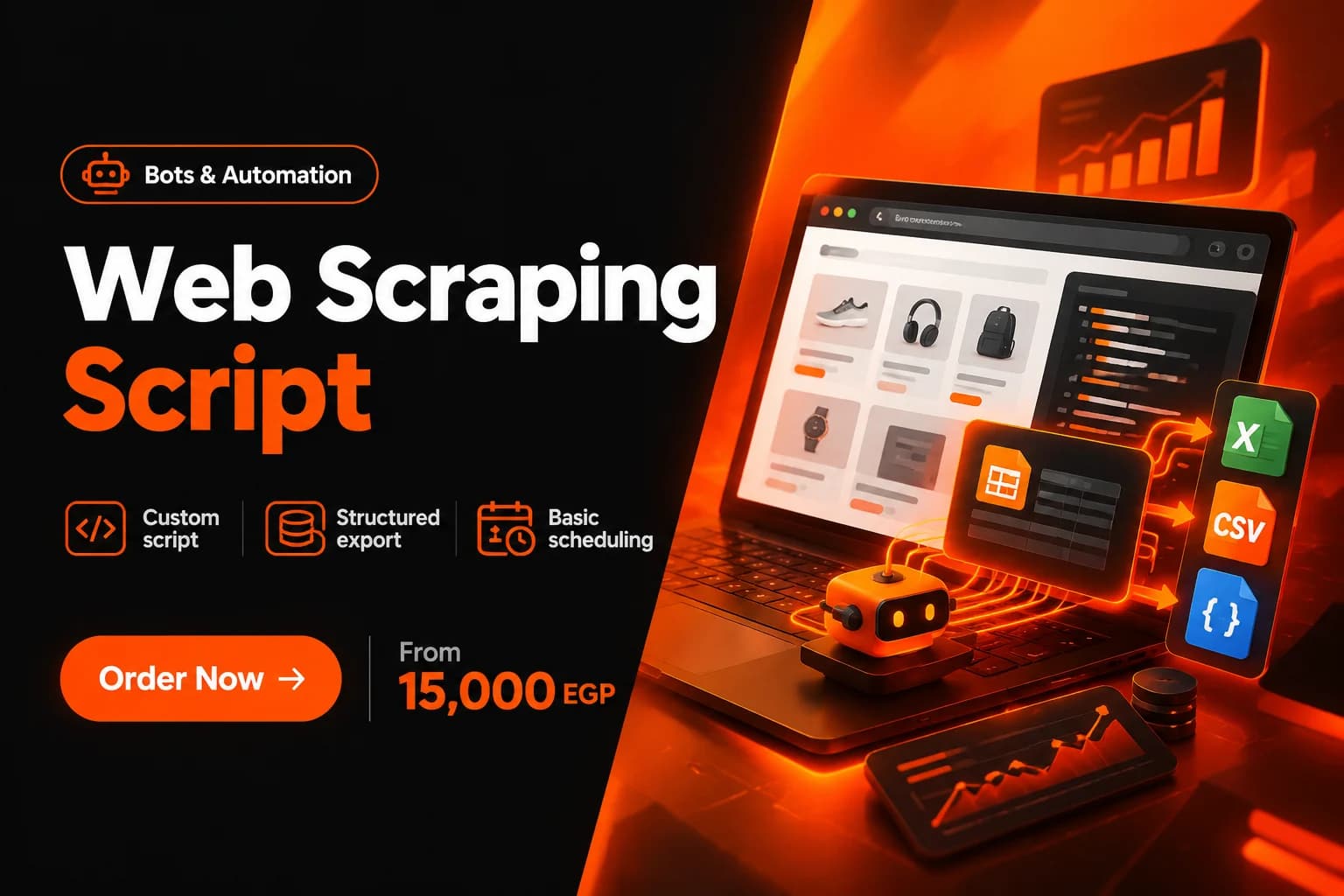
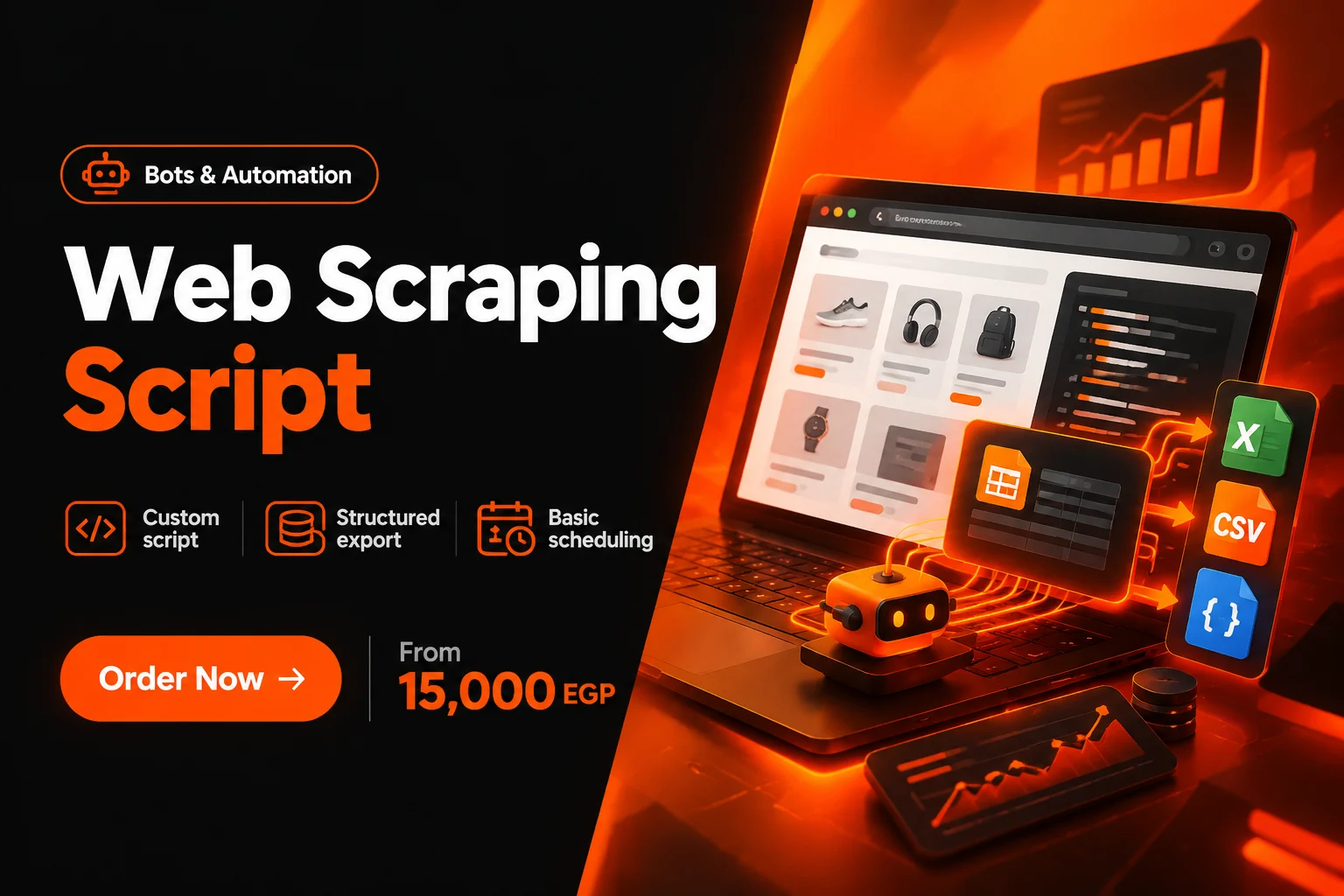
Turn Web Data into Growth Opportunities with a Custom Web Scraping Script
Valuable business information is spread across websites, product catalogs, public directories, industry portals, and other online sources. Collecting this information manually can consume significant time, introduce inconsistencies, and delay important decisions. With STRONG's custom Web Scraping Script service, your business can transform relevant web content into organized, usable data that supports research, automation, and sustainable growth. We develop tailored solutions that collect information from specified web sources according to your operational requirements, data needs, and business objectives.
As part of our Bots & Automation services, we approach web scraping as a practical way to simplify repetitive information-gathering tasks. Instead of relying on employees to repeatedly browse pages, copy details, and organize spreadsheets, you can use a dedicated script to automate suitable collection processes. The result is a more consistent workflow that helps your team spend less time gathering information and more time evaluating opportunities, improving operations, and making informed decisions.
A customized solution built around your goals
Every business collects information for a different reason. An e-commerce company may need product names, prices, availability, and specifications, while a marketing team may want to organize publicly accessible business listings or industry information for market research. STRONG designs each web scraping project around the information you actually need, the websites involved, and the way your team intends to use the collected results.
- Targeted data collection: Build a custom web scraping script that collects information from specified web sources according to your business needs and operational goals.
- Automated extraction and organization: Reduce manual work by collecting and structuring relevant information in a consistent format, making actionable data available faster for analysis and decision-making.
- Flexible automation solutions: Develop adaptable scripts within our programming, bots, and automation services while considering target websites' policies, terms of use, access restrictions, and applicable legal requirements.
From scattered web content to actionable information
The real value of web scraping lies not simply in collecting large volumes of information, but in making that information useful. A well-planned script can focus on relevant fields, follow defined collection rules, and organize results to support downstream business processes. Depending on the project, outputs may be structured for spreadsheets, databases, internal reporting, or integration with other business tools. The appropriate format and delivery method are determined by your requirements and the technical characteristics of the source websites.
STRONG prioritizes a clear scope, practical functionality, and a maintainable approach to automation. We consider the structure of target pages, the frequency of collection, expected data volume, and the reliability requirements of your workflow before shaping the solution. We also account for website rules and permitted access methods rather than treating every online source as unrestricted. Whether you want to reduce repetitive research, streamline data preparation, or establish a more efficient information-gathering process, a custom web scraping script can provide a practical foundation for your next automation initiative.
Web Scraping Script Deliverables and Available Integrations
STRONG develops custom Web Scraping Scripts that turn publicly accessible online information into structured datasets your business can analyze, manage, and use across its daily operations. Rather than relying on manual collection or disconnected spreadsheets, you receive a solution designed around your target websites, required fields, collection frequency, and preferred output formats. Every deliverable is aligned with the agreed project scope, helping your team build a dependable data collection process that supports research, market analysis, reporting, and business automation.
Targeted Data Extraction from Relevant Websites
The scraping script is configured to collect the specific information your project requires from approved sources. Depending on website structure, accessibility, and technical requirements, this may include product catalogs, published prices, product descriptions, public datasets, directory listings, and relevant published web page content. Extraction rules define which fields to capture, how records should be identified, and how the results should be organized. This targeted approach reduces unnecessary collection and keeps the resulting dataset focused on your business objectives.
- Extract product names, categories, descriptions, prices, and other agreed product attributes.
- Collect relevant public datasets, directory information, and published web content within the approved scope.
- Configure field selection and extraction rules according to the source structure and intended use of the data.
Data Cleaning, Validation, and Export Formats
Collected information becomes more useful when it is consistent, organized, and ready for analysis. STRONG can incorporate data processing steps that normalize formats, remove duplicate records, validate required fields, and handle missing or inconsistent values according to predefined rules. These measures help reduce data quality issues before information reaches your reporting tools or business applications. The final dataset can be delivered in a format that fits your existing workflow, without forcing your team to adopt an entirely new system.
- CSV and Excel: Suitable for spreadsheet-based analysis, operational reports, and sharing datasets across teams.
- JSON: Useful for application workflows, structured data exchange, and software integrations.
- Database storage: Support for suitable database systems when records need to be stored, queried, updated, or reused by other applications.
Scheduled Execution, Monitoring, and Reporting
For projects that require recurring updates, the script can be configured to run on an agreed schedule, subject to source availability and applicable access restrictions. Automated execution helps maintain current datasets without requiring staff to repeat the same collection process manually. Where required, the solution can also produce execution reports, record errors, and identify incomplete collection runs, making it easier to investigate problems and maintain operational visibility.
API, Database, and Business System Integrations
Web scraping becomes more valuable when the collected information reaches the systems that need it. STRONG can integrate the solution with available APIs, databases, internal dashboards, reporting tools, and other compatible business applications, depending on technical feasibility and project requirements. Data transfer rules can define how records are delivered, how updates are handled, and what happens when an integration fails. Before implementation, we establish the required access permissions, supported interfaces, data formats, and expected delivery frequency. The result is a practical Web Scraping Script that fits your existing technology environment and turns online information into a reusable business resource.
Technologies Used to Build a Web Scraping Script
Choosing the right technologies is essential to building a reliable, efficient, and maintainable Web Scraping Script. At STRONG, we select tools according to the structure of the target website, the volume of information required, the complexity of data extraction, and the way your business intends to use the results. Our approach combines suitable programming libraries, browser automation frameworks, databases, and integration technologies to create a solution that fits your operational requirements.
Python for Flexible and Efficient Data Extraction
Python is a practical choice for web scraping because it offers a mature ecosystem of libraries for requesting web pages, parsing HTML, processing information, and automating repetitive tasks. Its flexibility allows us to build scripts for everything from straightforward public-page collection to more complex workflows involving multiple sources and structured outputs.
- Requests: We use Requests to send HTTP requests and retrieve page content when the website allows direct access. This approach is lightweight and efficient for collecting information from accessible HTML pages and supported endpoints.
- BeautifulSoup: This library helps parse HTML and extract specific elements, such as product names, prices, descriptions, links, and publication dates. We configure extraction rules around the relevant page structure to produce consistent, organized records.
Playwright and Selenium for Dynamic Websites
Some websites generate their content through JavaScript, load information after the initial page request, or require interaction with page elements. In these cases, browser automation can provide a more appropriate technical solution than direct HTTP requests alone.
- Playwright: We can use Playwright to automate browser sessions, wait for dynamic content, navigate permitted pages, and retrieve information rendered by modern web applications.
- Selenium: Selenium is another option for automating browser interactions, particularly when project requirements or an existing technical environment make it a suitable fit.
Our developers choose between direct requests and browser automation based on actual technical requirements rather than adding unnecessary complexity. We also account for execution time, resource consumption, website terms, access permissions, and applicable restrictions when designing extraction workflows.
Databases, Docker, and API Integration
Extracted information becomes more valuable when it can be stored, processed, and delivered reliably. STRONG selects storage and integration technologies that match your data model, expected workload, and downstream applications.
- PostgreSQL and MySQL: Suitable for structured records, relational data, filtering, reporting, and applications that benefit from consistent schemas and database queries.
- MongoDB: Useful when collected records contain flexible fields or varying document structures that do not fit neatly into a fixed relational model.
- Docker: Helps package the scraping application and its dependencies into a consistent environment, supporting repeatable deployment and easier maintenance.
- APIs: Enable integration with compatible business applications, internal systems, dashboards, and automated processing pipelines.
A Technology Stack Built Around Your Goals
STRONG combines these technologies according to your project's specific needs, balancing extraction accuracy, scalability, maintainability, and cost. Whether you need a lightweight Python script or a browser-based automation workflow connected to a database and API, we build a practical technical foundation that helps turn accessible web information into dependable business data.
Web Scraping Development Phases from Planning to Deployment
Building a reliable web scraping script requires more than extracting information from a website. It involves understanding business objectives, evaluating data sources, testing extraction methods, and preparing a solution that can operate consistently as requirements evolve. At STRONG, we follow a structured development process that turns your data collection needs into a practical, maintainable automation tool. Each phase focuses on accuracy, reliability, and measurable outcomes, helping your team receive useful information without unnecessary manual effort.
Phase 1: Assess Data Sources and Define Requirements
We begin by identifying the websites and publicly accessible pages relevant to your project, then determine how their information should be collected and organized. This discovery phase establishes a clear technical scope and prevents avoidable issues during development. Our team works with you to define the required fields, expected dataset size, collection frequency, preferred export formats, and criteria for evaluating successful delivery.
- Identify target websites, relevant page types, and accessible data sources.
- Specify fields such as product names, prices, categories, URLs, descriptions, or publication dates, depending on the project.
- Estimate data volume, pagination requirements, and expected collection frequency.
- Select suitable output formats, including CSV, JSON, Excel-compatible files, or database storage.
- Establish measurable acceptance criteria for completeness, accuracy, processing time, and successful execution.
Phase 2: Develop and Test a Working Prototype
Before expanding the solution, we build a focused prototype to verify that the planned extraction method works with the selected sources. This stage helps reveal practical limitations early, including inaccessible pages, inconsistent content, pagination behavior, dynamically rendered elements, and changes in website structure. We test representative records against the original pages to evaluate whether the extracted values accurately reflect the intended information.
- Test data accessibility and determine the appropriate extraction approach for each source.
- Validate field mapping, text cleanup, duplicate handling, and extraction accuracy.
- Examine pagination, missing values, variable page layouts, and potential failure scenarios.
- Identify reasonable retry strategies, error handling requirements, and source-specific constraints.
- Refine the prototype based on test results before proceeding to full implementation.
Phase 3: Implement the Complete Script and Validate Data Quality
Once the prototype meets the agreed requirements, we develop the complete web scraping script with appropriate processing logic, output handling, and safeguards. We then run validation checks to identify incomplete records, unexpected data types, duplicates, and formatting inconsistencies. These checks help ensure that the resulting dataset is suitable for reporting, analysis, research, or downstream business automation.
Phase 4: Configure Deployment, Scheduling, and Monitoring
STRONG prepares the script for its intended operating environment, whether it runs on a local machine, a business server, or a supported cloud environment. Where recurring collection is required, we configure scheduling and establish monitoring practices that help identify failed runs, unusual results, and source changes. We also prepare practical documentation covering setup, configuration, execution, troubleshooting, and routine maintenance.
Phase 5: Deliver and Support Operational Readiness
Before handover, we review the agreed acceptance criteria, confirm the expected output format, and provide the completed script with clear operating instructions. The delivery includes guidance on execution, scheduling, common errors, and future updates. This structured approach gives your business a dependable starting point for collecting web data while making ongoing operation and maintenance easier to manage.
Performance Optimization and Search Engine Readiness
A successful Web Scraping Script should do more than collect information accurately. It should operate efficiently, handle changing website conditions, protect sensitive data, and support a reliable automation workflow as your business grows. At STRONG, we focus on performance optimization and technical reliability to help ensure that your scraping solution delivers consistent results without consuming unnecessary resources. We also consider search engine readiness when optimizing the service landing page, making it easier for potential customers to understand the service and discover relevant information through organic search.
Improve Scraping Efficiency and Resource Management
Large-scale data collection can place unnecessary demands on processing resources and target websites when requests are not managed properly. Our approach focuses on balancing collection speed with stability, using controlled concurrency, intelligent caching, and carefully managed retry mechanisms. These techniques help reduce redundant operations and improve the efficiency of recurring data extraction tasks.
- Controlled concurrency: Manage the number of simultaneous requests according to the target website's limitations and the available system resources.
- Intelligent caching: Reuse previously collected information when appropriate to avoid retrieving unchanged data repeatedly.
- Managed retries: Apply configurable retry policies, delays, and backoff strategies to handle temporary failures without generating excessive requests.
- Efficient processing: Optimize data parsing, transformation, and storage workflows to reduce processing overhead and improve overall responsiveness.
These improvements can make scheduled collection more predictable and help the script remain maintainable as data volumes increase. Performance decisions are tailored to the source websites, update frequency, and business requirements rather than relying on a one-size-fits-all configuration.
Data Quality, Monitoring, and Security
Reliable automation depends on trustworthy output and clear visibility into operational issues. STRONG can incorporate validation rules that identify missing fields, unexpected formats, duplicate records, and incomplete results before the collected information reaches downstream systems. Error monitoring provides useful diagnostic information when website structures change, requests fail, or integrations become unavailable.
- Data validation: Check required fields, data types, formats, and consistency against defined business rules.
- Error monitoring: Record relevant failures and operational events to support troubleshooting and timely maintenance.
- Credential protection: Store API keys, passwords, and other secrets using appropriate secure configuration and secret-management practices.
- Access controls: Restrict administrative functions and sensitive resources to authorized users and services.
- Secure integrations: Use encrypted connections and appropriate authentication when exchanging information with supported external systems.
We also consider applicable website terms, access restrictions, privacy obligations, and responsible request practices when designing data collection workflows.
Prepare the Service Landing Page for Search Engines
Technical performance and useful content both contribute to a better online experience. For STRONG's Web Scraping Script service page, optimization can include clear headings, informative descriptions, relevant internal links, and responsive layouts that work smoothly on mobile devices. We also consider page loading performance, content organization, and the natural use of relevant search terms so visitors and search engines can understand the service more easily.
Search engine optimization is an ongoing process, and specific rankings cannot be guaranteed. By combining efficient automation, secure data handling, useful service content, and mobile performance improvements, STRONG helps businesses build a more dependable technical solution and a stronger foundation for long-term online visibility.
Who Needs a Web Scraping Script? Start Your Project with STRONG
A custom Web Scraping Script is valuable for businesses that rely on accurate online information to make decisions, identify opportunities, and improve operational efficiency. Instead of collecting website data manually, organizations can automate repetitive tasks and transform relevant public web content into structured information that supports everyday workflows. STRONG develops tailored web scraping solutions for different industries, project sizes, and business objectives, helping teams obtain the data they need without unnecessary manual effort.
Businesses and growing companies can use web scraping to research markets, identify industry trends, monitor competitors, and maintain organized databases. Access to regularly collected information helps decision-makers compare market conditions, evaluate opportunities, and prepare business reports using consistent data. Whether the objective is building an internal research database or supporting a larger automation process, a custom script can be designed around the sources and fields that matter most to the organization.
E-commerce stores and online retailers can benefit from automated product and price monitoring. A web scraping solution can collect publicly accessible information such as product names, listed prices, availability indicators, categories, and selected product attributes. This information can help teams compare competing offers, review pricing trends, identify catalog gaps, and support product research. Collection schedules can be aligned with business needs, allowing retailers to refresh relevant datasets periodically rather than repeatedly checking websites by hand.
Marketing teams and digital agencies can use structured web data to strengthen market research, content planning, campaign analysis, and competitive monitoring. Depending on the source and applicable permissions, scraping scripts can gather information from public directories, industry websites, and other relevant online resources. Organizing these records into consistent formats makes it easier to filter information, identify patterns, and transfer useful data into existing reporting or marketing workflows.
Researchers, analysts, and data-driven projects may need to gather information from multiple online sources for comparison, trend analysis, or database development. A custom script can help standardize selected fields, reduce repetitive collection work, and prepare datasets for further analysis. The implementation can account for source structure, data quality requirements, collection frequency, and the preferred output format, helping ensure the resulting information is suitable for its intended use.
Common projects that benefit from recurring web data collection include:
- Price and product monitoring: Track selected product details and publicly listed prices across relevant websites.
- Database maintenance: Collect and refresh structured records from approved public sources.
- Business intelligence: Prepare datasets for market comparisons, internal reports, and strategic analysis.
- Marketing research: Organize relevant public information to support competitor research and campaign planning.
- Academic and industry research: Gather comparable information for analysis, subject to source restrictions and research requirements.
Start your Web Scraping Script project with STRONG. Visit strong-pnd.com to discuss your goals, target websites, required data fields, collection frequency, and expected deliverables. Our team can assess the project scope, identify technical considerations, and recommend an approach aligned with your workflow. We consider data structure, reliability, scalability, and applicable website terms and access restrictions when planning the solution. Whether you need a focused script for a single source or a broader data collection workflow, STRONG can help turn your requirements into a practical automation project built around your business needs.